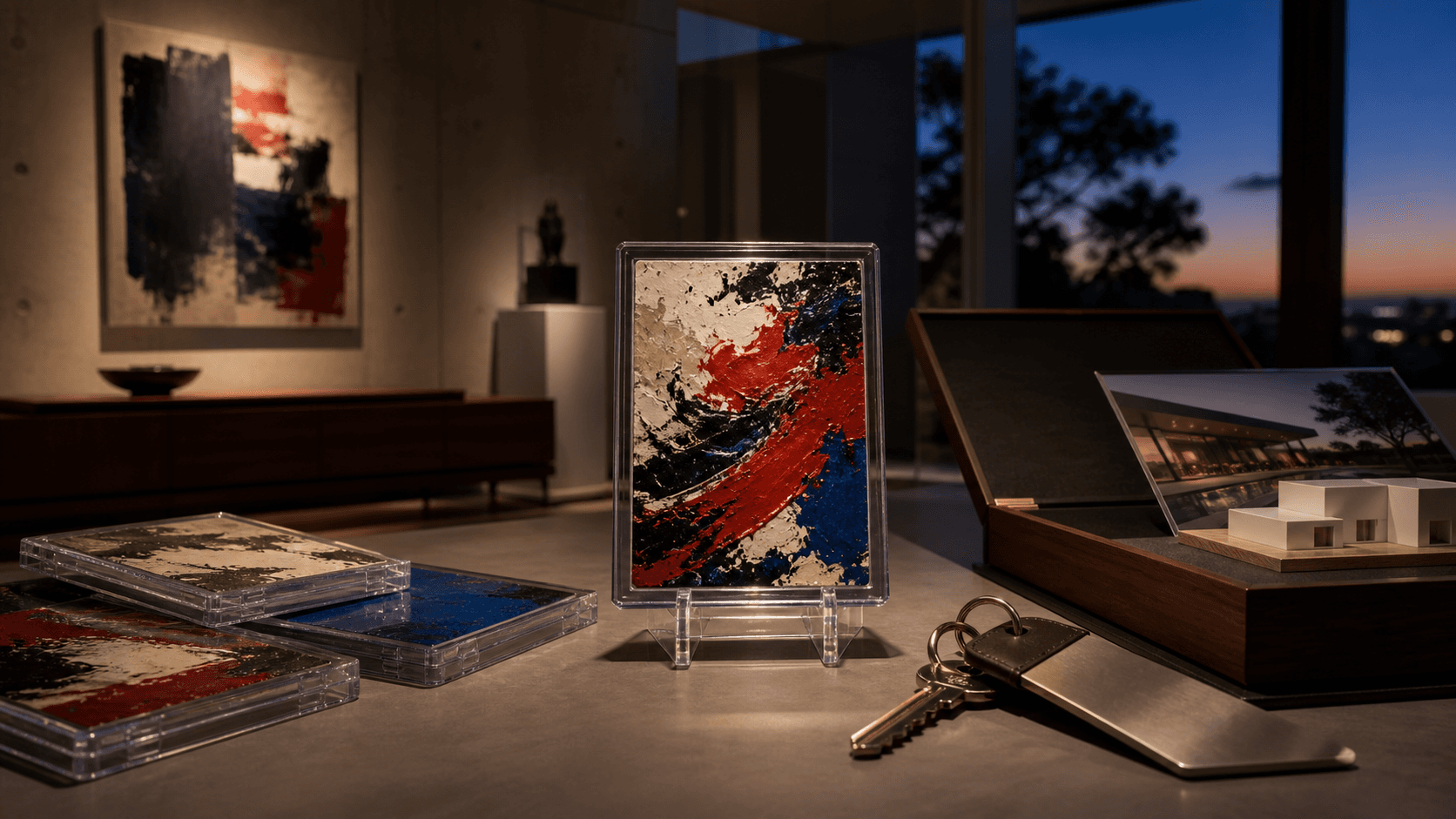
David Choe painted on a Shohei Ohtani baseball card and walked away with about $700,000 in stuff. Not cash. Stuff.
No money changed hands. The whole thing was a barter, struck at a trade night at RWT Collective on Sawtelle Blvd in West LA. Yahoo Sports and Mantel, both reporting work by Sam Goodman, called it one of the most unusual deals in recent hobby memory.
That framing matters. This is not "the largest art-card trade ever." It's a private, self-valued swap. But it's a big one, and it's the exact collector impulse behind art cards taken to its outer edge.
What Each Side Walked Away With
Choe got roughly $700,000 in goods on his side of the ledger.
About $500,000 of that was luxury hospitality and destination-property access from the Stay Fieldtrip portfolio. That includes stays at Joshua Tree's mirrored "Invisible House" and the "Avocado House." The other ~$200,000 came in sports cards and collectible inventory.
On the other side was Josh Seigel. He received a hand-painted 1/1 Choe artwork on a Shohei Ohtani trading card, plus around 20 more Choe-created cards and artworks, plus artist-created collectibles.
The Ohtani piece blends the player with what the article describes as "DC Comics' gritty Absolute Batman aesthetic." Among the assets that moved, an Ohtani "Alter Ego" card valued around $9,000 raw was confirmed in the mix.
How a Deal This Strange Came Together
Seigel found Choe through Anthony Bourdain. Choe traveled with Bourdain on his show years ago.
When Choe mentioned he'd rather trade his work than sell it, Seigel reached out on Instagram. That's the whole origin story. A cold DM built on a Bourdain connection.
Danny Leserman owns Culver Collectibles, the sports-card arm of RWT Collective. In the original reporting by Sam Goodman for Mantel and Yahoo Sports, Leserman framed the giant deals the same way he frames small ones. "The biggest trades are shockingly similar to the smallest ones. The only difference is the number of zeros."
The deal wasn't perfectly clean. Per the reporting, there were post-deal mix-ups. Choe thought an Ohtani All Kings card was part of the package, and Seigel sent it anyway to keep the relationship intact.
A Cooper Flagg acquisition fell through, and Choe declined two five-figure alternatives. Both sides chose the relationship over re-litigating the terms.
Why Choe Trades Instead of Selling
This connects to Munko, Choe's collecting world where cards function as access points to experiences and events. The card isn't the endpoint. It's a key.
That reframes the whole deal. The $500K in Stay Fieldtrip access isn't a weird substitute for money. For Choe, it's the actual point. The cards he painted are tokens that move people into rooms and houses and experiences.
Choe's history explains the rest. He took Facebook stock instead of roughly $60,000 cash for murals he painted at the company's first office in 2005. By the 2012 IPO, that stake was estimated to be worth around $200 million. The man has a long track record of valuing access and upside over a check.
Is It a Record? Here's the Honest Version
Short answer: nobody can call this a record, and the smart money shouldn't try.
A private, self-valued barter and a public auction result are not the same measurement. One is two parties agreeing on a number in a room. The other is open bidding with a hammer price anyone can verify.
Here's the contrast that makes the point. Choe's auction record for a painting is around $32,760 ("Fist Hugger," Christie's, 2022). A single hand-painted card in this trade was valued, by the parties, near the center of a deal worth half a million dollars on his side.
Sketch cards have their own verified high. A 1993 SkyBox Simpsons "Art DeBart" card by Matt Groening sold for $24,375 at Heritage. That's an auction-confirmed number. A self-valued private swap is apples to oranges next to it.
So the headline figure is real as a deal value. It just isn't a market comp.
What It Means for Art Cards
Strip away the celebrity and the helicopter-tour money, and this is the same thing happening on art-card platforms every day. As Leserman put it in the original reporting, the only difference is the number of zeros.
An artist makes a 1/1 on a 2.5 x 3.5 card. Someone wants it badly enough to give up something real to get it. That's the entire engine behind ACEOs and art cards. The value is the artist, and the buyer is chasing the person, not the cardstock.
We've written before that art-card value rests on a living, producing artist, and that a slab doesn't create value on its own. The honest pricing guide lays out the real numbers, where hand-drawn cards run $20 to $80 and produced pieces reach into the thousands on the secondary market. Choe is the extreme tail of that same curve.
It's also a reminder that the base card underneath matters less than people think. The somos.index post identified the painted base as a 2024 Topps 50/50 Ohtani card, and the All Kings and Alter Ego cards floating around the deal are real Topps products. But Choe's painting is what made the card worth painting over.
The same logic runs through the high end of the official card world too, like the Topps Series 1 Ohtani 1-of-1 patch that collectors chase for rarity, not raw materials.
Marketplaces built for this exist now. Nerdworth runs the art-card side of it, where one-of-one painted cards trade between artists and collectors without a single dollar of seller fees.
Most of those deals are $40, not $400,000, and our marketplace guide maps where they actually happen. The impulse is identical.
A guy painted a baseball card and turned it into a half-million-dollar barter. That's not a market correction or a record. It's proof that a 1/1 piece of art on a card is worth exactly what one collector will give up to own it.
Editor's note (August 31, 2026): This article was updated to attribute the framing on trade sizes to Danny Leserman and the original reporting by Sam Goodman for Mantel and Yahoo Sports.
Sources
- The $700K Trade Connecting Fine Art, Real Estate & Collectibles (Yahoo Sports)
- The $700K Trade Connecting Fine Art, Real Estate & Collectibles (Mantel)
- 2025 Topps Series 2 All Kings checklist (Sports Illustrated / cllct)
- 2024 Topps 50/50: Shohei Ohtani (BaseballCardPedia)
- David Choe sold-at-auction prices (Invaluable)
- 1993 SkyBox "Art DeBart" Simpsons sketch card sells for $24,375 (Sports Illustrated)