Yes. But "ACEO" covers two different markets, and only one of them has real resale value.
A hand-drawn art card from an unknown seller is worth a few dollars, maybe up to eighty. A slabbed, produced art card from an artist people follow can sell for hundreds and resell for thousands. Same 2.5 x 3.5 inches. Completely different economics.
And there's a catch underneath all of it that no slab pitch will tell you. We'll get to that.
The numbers here come from Nerdworth's own marketplace data. We run the marketplace, so this is first-party, not scraped guesswork. (New to the format? Start with what ACEO cards are. This guide assumes the basics and goes straight at value.)
So Are ACEO Cards Actually Worth Anything?
Depends which kind. There are two markets wearing the same name.
Hand-drawn ACEOs and sketch cards. A raw watercolor, marker, or pencil card, made by hand, usually by an independent artist. These mostly trade for $5 to $80. The secondary market is thin. Someone buys it, it goes in a binder, and it rarely changes hands again. If you own these, own them because you like looking at them.
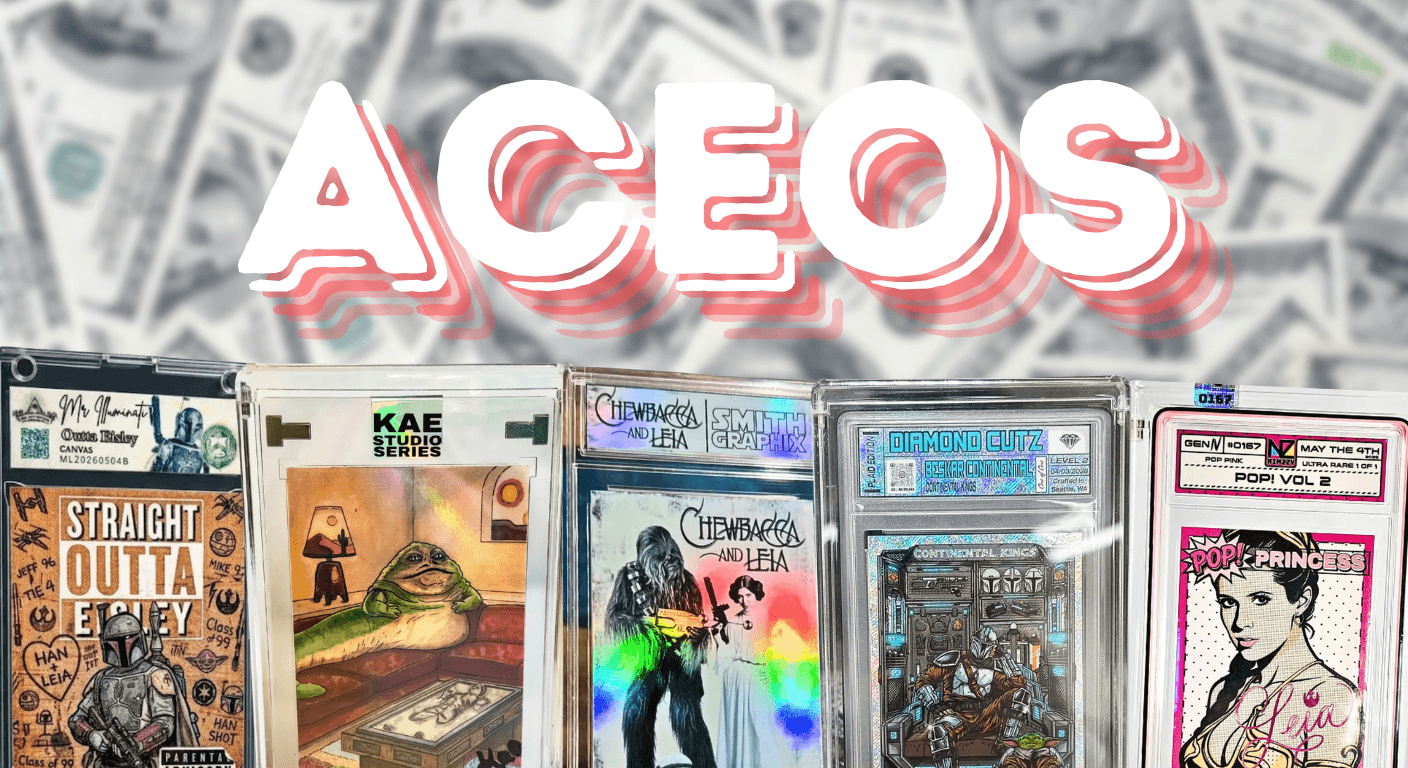
Produced art cards. Printed or finished pieces, usually slabbed, often built around popular IP, sold as a packaged drop. These trade higher, and they have a genuine, active secondary market. They resell. Some climb hard. This is where the real money in the format lives.
Knowing which one you're holding is the whole game.
What They Actually Sell For (Real Numbers)
Here's what our data shows. Two cuts, because the two markets behave differently.
Maker-direct, primary sales. Across Nerdworth's own on-platform art-card sales (N=155, January to May 2026), the median piece sold for $77.50, with the middle half landing between $30 and $100. Active art-card listings ask a median of about $80 right now. That matches the working rule of thumb: hand-drawn ACEOs run $20 to $80, slabbed art cards $50 to $250, and anything above $150 is expected to show up with a box, packaging, and an acrylic slab.
The secondary market. Across our broader tracked dataset, including secondary-market comps from eBay, Discord, and private sales (N=3,461, 2022 to 2026), the median jumps to $675. Most sales cluster between $500 and $5,000, and the top tracked sale approached $100,000. That is not hand-drawn ACEOs. That is the produced, slabbed, IP-driven art-card market reselling, and it is real and active.
For the floor, look at raw eBay listings from unknown artists. Those cards start in the single digits. That's the bare hand-drawn market, and it's where an unknown artist's raw card starts.
One more number worth knowing. Of the 43 collectors who bought art cards on Nerdworth in 2026, about 35% came back and bought again, averaging 2.3 orders and $270 in lifetime spend. This is a small, devoted base. Not a mass market. A handful of buyers who care a lot.
What Drives the Price
A handful of things move an art card's price, in roughly this order.
Artist reputation. This is the biggest lever by far. An artist with a name, a following, and collectors chasing every drop can charge multiples of an unknown selling the same subject at the same skill level. The value is the person.
Original versus edition. A true one-of-one beats a numbered print, which beats an open print. One artist, one card, one owner carries the weight.
Medium and production. Hand-painted oil and watercolor read as labor. On the produced side, a slabbed piece with a clean print, a holo, and real packaging reads as a finished object. A flat inkjet print reads as a copy.
Subject. The IP people already love moves. More on which IP below.
Detail and signature. What the artist pulled off at 2.5 x 3.5 inches, plus a signed back and a certificate of authenticity tying it to a real career.
One hard line: a plain giclee or inkjet print carries little resale value. It's infinitely reproducible. Value lives in the one-of-a-kind original or the genuinely limited, produced piece.
Do They Hold Value or Appreciate? The Honest Answer.
For hand-drawn ACEOs: rarely. Thin resale, mostly flat or down. Buy for love, not gains.
For produced art cards: yes, some do, and our secondary data proves a real resale market exists. But appreciation is not a property of the format. It's specific to the artist, and even to the individual piece. Some pieces climb. Some sink. There is no index quietly going up that you can buy into.
What separates a piece that appreciates from one that craters is almost always the artist behind it. Which brings us to the catch.
The Catch: Value Follows Momentum
This is the part no one selling you a slab will say out loud.
An art card's value is tied to a living, producing artist. It is not a static collectible like a vintage rookie. The card is worth something because the artist is active, dropping new work, and collectors want in.
Stop producing for a stretch and the value drifts down. Quit, and it goes to zero. Your most valuable piece is never the one you made last year. It's the next one. Collectors buy momentum, not inventory. An artist who walks away leaves a catalog that stops selling at any price.
So if you're buying produced art cards as an investment, understand the actual bet: that a specific human keeps making art people chase. That's a wager on a person, not a collectible. It can pay well. It can also evaporate the day they put the brushes down.
The Slabbing Question
Crossover collectors from sports cards see a slab and assume the case adds value. On its own, it doesn't.
The produced art cards that resell for hundreds are slabbed, true. But they don't trade high because of the acrylic. They trade high because of the artist, the IP, the production, and the momentum behind them. Encasing an unknown's $20 original in a slab does not make it a $200 piece. It makes it a $20 piece that's harder to damage.
The slab is real protection from UV, moisture, and handling, and it's the expected format for a serious produced piece. Just don't confuse the case with the value. The value is the artist.
For Artists: How to Price Your Own
Price to the market you're actually in.
Hand-drawn and unslabbed: $20 to $80 is the working range. Start at the low end if you're unknown and raise as demand builds.
Slabbed and produced: $50 to $250. Above $150, collectors expect the full experience, a box, packaging, an acrylic slab. The price has to carry the production cost, which can run $50 or more per piece once you add the slab, the case, the box, and the packing.
Know your sell-through. Most artists move 30 to 40 percent of what they make, and that's a healthy number. The best sell out. You are not failing if half a drop sits. That's average, and average is fine.
Raise price with reputation, not hope. Every sale, every follower, every repeat buyer earns you room to charge more. The artists clearing the high end got there by building demand first. The price followed the following.
And factor in fees before you set the number. Which brings us to the part that quietly decides whether any of this is worth your time.
The Fees Will Eat You Alive (Do the Math)
On art that sells for $20 to $80, platform fees matter more than almost any other variable. A few dollars off a $40 sale is a real slice of your work.
Run a $25 sale across the major venues:
eBay: 13.6% final value fee on art for sellers without a store subscription, as of June 2026, plus a $0.30 to $0.40 per-order fee. Your $25 nets about $21.20. Pay for a Basic Store or above and the art rate drops to 12.7%, which nets about $21.42.
Etsy: 6.5% transaction plus a $0.20 listing fee plus 3% + $0.25 processing. Roughly $22.12 before offsite ads. Once offsite ads hit, the effective take climbs into the 13% to 25% range.
Nerdworth: zero seller fees. Your $25 is $25.
That last line is the math, not a sales pitch. Nerdworth charges artists nothing on a sale, which on thin-margin art cards is the difference between a sustainable practice and a hobby that costs you money. Full disclosure, Nerdworth is ours.
For the full platform-by-platform fee tables and where to actually list, see the ACEO marketplace guide. The point here is narrower. At these price points, the fee is part of the price.
Bottom Line
ACEO covers two markets. Hand-drawn cards mostly sell for $20 to $80 with little resale. Produced, slabbed art cards sell for $50 to $250 new and have a real secondary market that reaches into the thousands, with our tracked median at $675.
But all of it rests on one fragile thing: a living artist who keeps producing. The value is the momentum. When the artist stops, the value stops. Buy what you love at the low end, bet on people at the high end, and never mistake a slab for a sure thing.