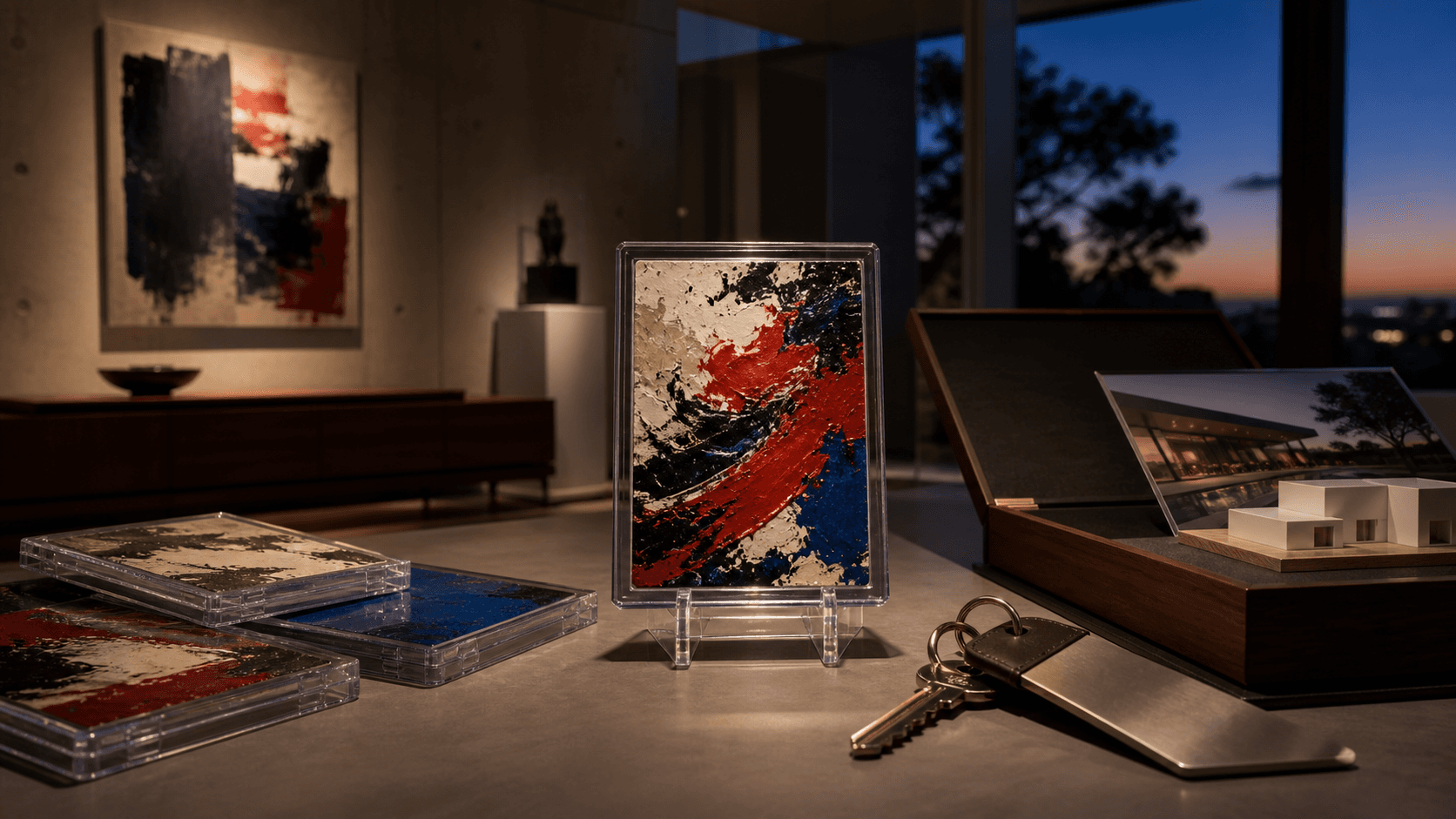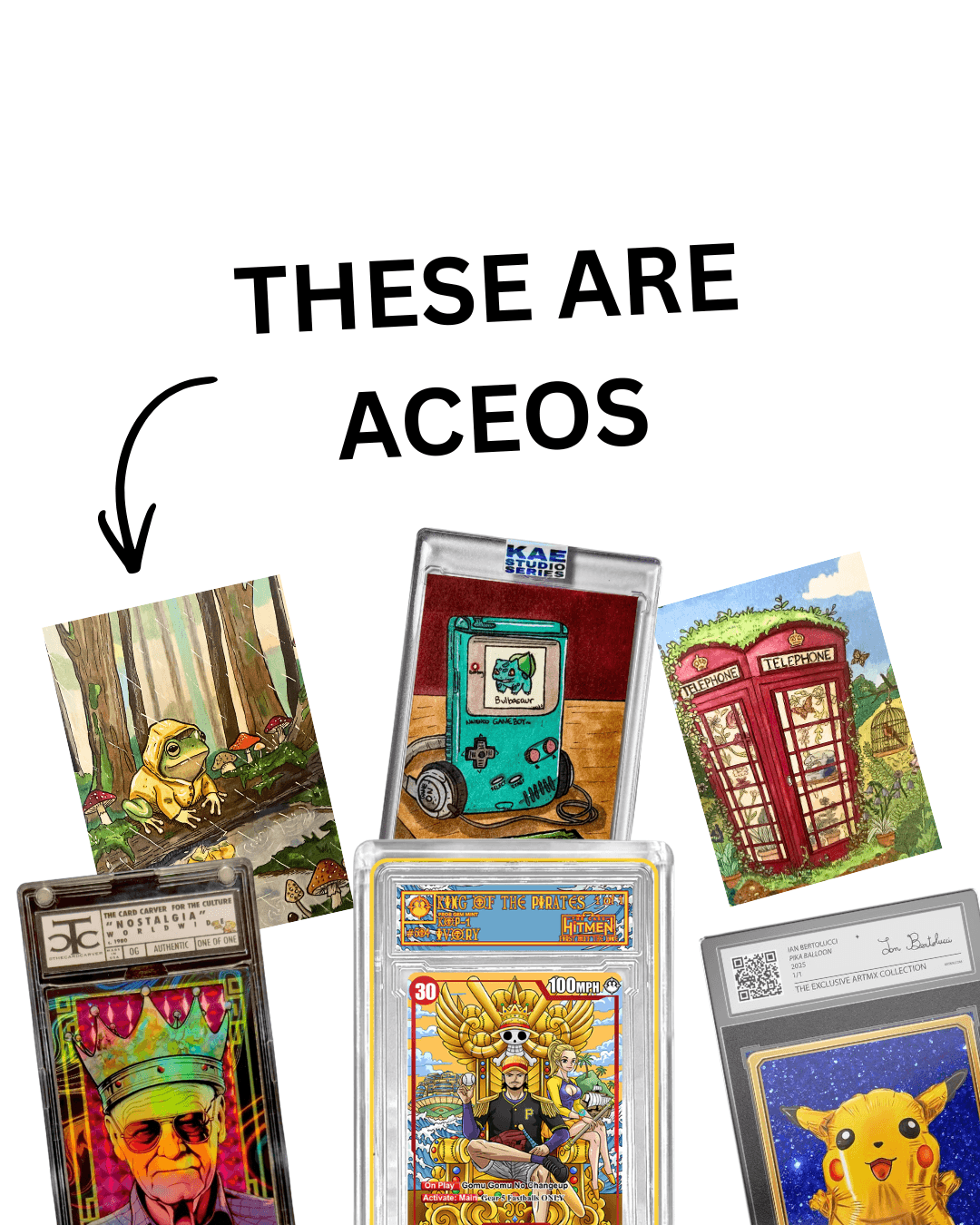
A piece of original art the size of a baseball card. Hand-painted. One of one. Signed by the artist. Fits in a penny sleeve, a top loader, or a graded slab. Ships for a few bucks.
That's an ACEO.
The format has been around for over 20 years. But something changed in the last two years. The same collectors who chase vintage Topps and Pokemon slabs started paying attention to hand-made art cards. And the market noticed.
The Basics
ACEO stands for Art Cards, Editions and Originals. The only hard rule is size. Every ACEO measures exactly 2.5 x 3.5 inches (6.4 x 8.9 cm). Standard trading card dimensions. Same as a baseball card, a Pokemon card, a Magic card. That's the entire spec. There is no other rule.
Any medium counts. Watercolor, acrylic, oil, ink, pencil, charcoal, collage, photography, digital prints, mixed media. Some artists work in 3D. If it's 2.5 x 3.5, it qualifies. The format doesn't care how you make it. It cares that you made it.
The name splits into two things. Editions are limited print runs of an image, usually capped at 9 and numbered (1/9, 2/9, and so on). Originals are one-of-one handmade pieces. No copies. The artist made one, and you're holding it. Originals carry the weight in this format. An edition print is a copy of art. An original is the art.
The term was coined on eBay around 2004 by Colorado artist Lisa Luree, who needed a way to distinguish art cards that were for sale from ones that were only for trading. eBay later gave her a Community Hall of Fame Award for building the category. That distinction between sellable and trade-only is the whole reason the word exists.
ACEOs vs. ATCs vs. Sketch Cards. Same Size. Different Rules.
Three formats share the 2.5 x 3.5 size. The rules are what separate them.
ATCs came first. Artist Trading Cards were invented in 1997 by Swiss artist M. Vanci Stirnemann, who showed 1,200 of them at a Zurich gallery and ended the exhibition with the first trading session. Canadian artist Don Mabie carried the idea across the Atlantic and ran the first North American session in Calgary that same September. The founding principle was simple. You can trade them. You can never sell them.
That worked when the community was small and everyone could meet in person. But as the format spread online, artists started getting requests from collectors across the country who had no way to trade in person. They just wanted to buy.
ACEOs solved that problem. Same 2.5 x 3.5 format, built for the commercial market. Buy them. Sell them. Collect them. No rules about trading only. The format went international along the way. In Germany the equivalent is called KaKAO. Same concept, different language.
Sketch cards are the third cousin. These are hand-drawn cards commissioned by companies like Topps and Upper Deck, inserted into commercial products or handed out through redemption programs. The earliest mainstream example was the 1993 SkyBox Simpsons "Art De Bart" redemption, with only 400 cards drawn by Matt Groening. One of those sketches later sold for $24,375. The difference that matters: a sketch card's value is tied to the brand and product it came from. An ACEO's value is tied to the artist who made it.
All three still exist. ATC communities are active and protective of the no-sale tradition. Sketch cards live inside the licensed card world. ACEO is what you'll find on marketplaces, at auction, and in independent collections.
Why the Format Is Blowing Up
Three things converged.
The sports card boom trained a generation of collectors. Millions of people spent the last five years learning about slabs, grading, one-of-ones, and card-size collectibles. They understand the format instinctively. When they see an original painting the size of a Prizm base card, they get it immediately. No explanation needed.
Original art became accessible. A gallery painting costs hundreds or thousands. An ACEO original costs $5 to $50 for most artists. Some established names push higher. But the entry point for owning a hand-made, signed, one-of-one piece of art is lower than it has ever been.
Social media made the process visible. TikTok and Instagram turned ACEO creation into content. Artists film themselves painting a 2.5 x 3.5 card in real time. Thirty seconds. Satisfying result. Link in bio. The format is built for short-form video in a way that canvas painting never was.
What Makes a Good ACEO
Not all art cards are created equal. If you're collecting for keeps, look for three things.
Originality. A one-of-one original will always hold more weight than a print run. Prints have their place, especially limited editions, but the heart of the ACEO format is the hand-made original. One artist. One card. One owner.
Provenance. Is it signed? Is the artist established? Do they have a body of work you can trace? A signature on the back of the card ties it to a real person with a real career. That matters as the collection grows.
Condition and presentation. Raw cards are fine for trading and casual collecting. But if you're building a serious collection, how the card is stored and protected matters. Top loaders, magnetic cases, and professional slabs all extend the life of the piece and signal that you're treating it like the asset it is.
The Slabbing Movement
This is where things get interesting for crossover collectors.
The sports card world made graded slabs the gold standard. PSA, BGS, CGC. A raw card is worth X. A slabbed card is worth more. Collectors internalized that logic over decades.
Now apply that to original art.
Artists and studios are encasing ACEOs in acrylic slabs with embedded signatures and edition info. The card becomes a sealed, self-contained art object. No frame needed. No glass. Just pick it up and look at it.
The slab protects the art from UV, moisture, handling damage, and time. It also signals permanence. This isn't a loose piece of paper in a box. It's a finished object.
For collectors coming from sports cards, slabbed ACEOs feel familiar. Same display case. Same shelf. Same protective instinct. Different asset class.
How Collectors Display Them
The size is both the challenge and the advantage.
ACEOs fit anywhere. Desk, bookshelf, floating shelf, display cabinet, card binder. A collection of 50 pieces takes up less space than a single framed canvas.
Most collectors display favorites and store the rest. Card binder pages with nine-pocket sleeves hold ACEOs perfectly. Same pages used for baseball cards and Pokemon. One binder can hold hundreds of pieces.
Slabbed ACEOs stand on their own. Literally. The acrylic slab sits upright on any flat surface. Three slabs on a desk and you have a gallery.
Where to Find Them
ACEOs live everywhere. eBay has the most volume by far. A search for ACEO returns over 59,000 listings in the paintings category alone as of June 2026. Etsy has a strong handmade community. Instagram and TikTok are where artists sell direct.
Dedicated platforms are emerging too. Nerdworth runs the largest ACEO artist database with themed auction events and zero seller fees. The format finally has infrastructure built specifically for it, not just general marketplaces where art cards sit next to phone cases.
The community also thrives on DeviantArt, Discord servers, and collector groups on Facebook. It's decentralized. Artists sell where their audience lives.
The Price Range
Most ACEOs sell between $5 and $50. That's the sweet spot for the format. Affordable enough to collect in volume. Valuable enough that artists can sustain a practice.
At the high end, established ACEO artists and limited series from recognized names can push into the $100 to $500 range. Slabbed pieces from artists with strong followings trade at premiums.
At the low end, you can start a collection for less than the price of lunch. Five original paintings by five different artists for under $50. Try doing that with any other art format.
So why does one card sell for $5 and another for $200? Originals beat editions, every time. After that it comes down to the artist's reputation, the medium (hand-painted oil and watercolor tend to command more than digital prints), the subject (fan art of popular franchises, animals, and fantasy themes sell consistently), and how much detail the artist pulled off on a canvas the size of a playing card. The 2.5 x 3.5 format forces economy. Every brushstroke counts at this scale, and collectors can tell the difference between an artist who paints small and one who shrank a big composition down to fit.
Getting Started
Buy what you like. That's the whole strategy.
ACEOs are small enough and cheap enough that you can experiment. Grab a card from an artist whose style catches your eye. If it sits on your desk and makes you look at it twice a day, buy more from that artist.
Follow artists on Instagram and TikTok. Watch them create. When you see something you want, move. The best one-of-one pieces sell fast because there's only one.
Check Nerdworth's auction events for themed drops where multiple artists contribute to a single collection. It's the fastest way to discover new artists in the format.
And if you're an artist reading this, the barrier to entry is a piece of cardstock and a pen. 2.5 x 3.5 inches. That's all the space you need.