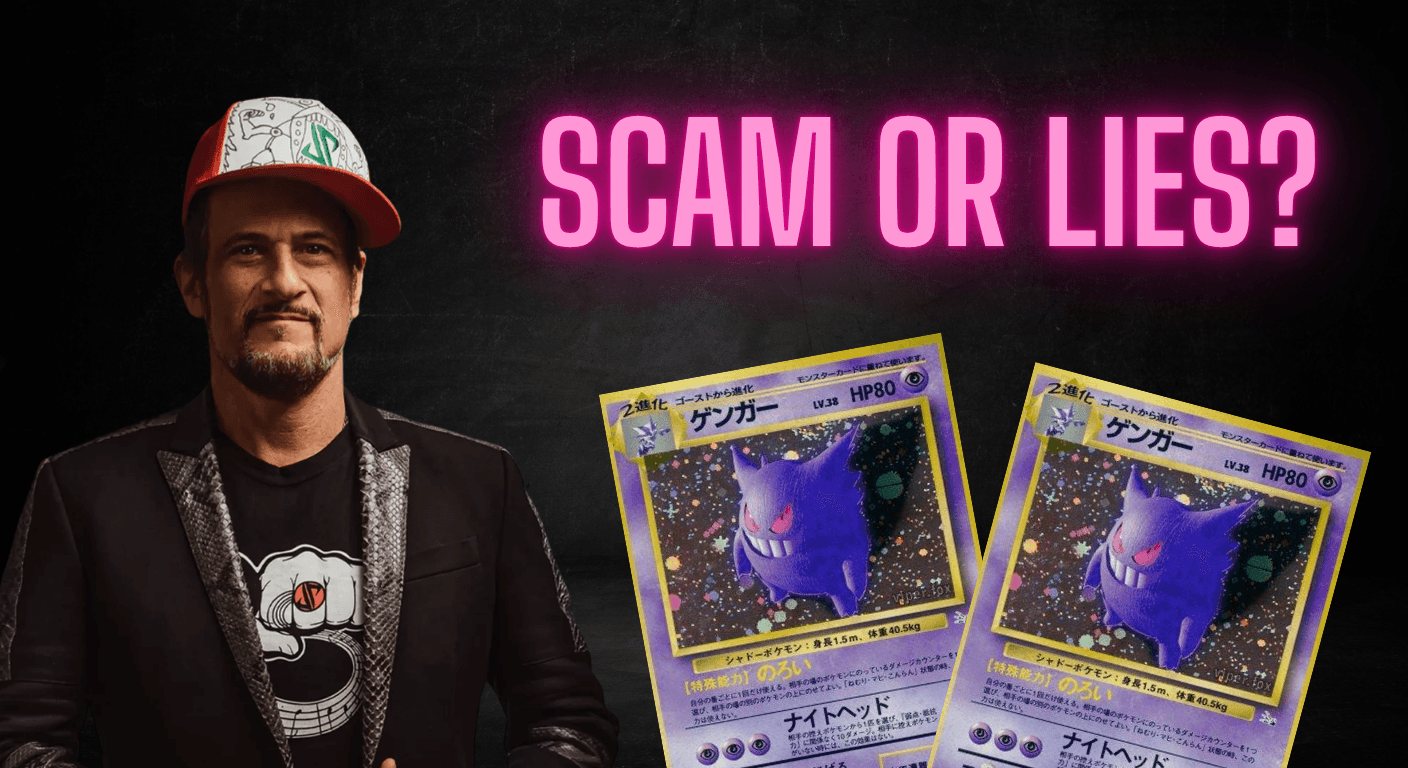
The man who sang "Gotta Catch 'Em All" is now at the center of a scam accusation over a Pokemon card trade with two kids.
Jason Paige sang the original English Pokemon theme. Newsweek confirmed it. In early June 2026, a vendor operating as "Boosters and Bangers" posted videos calling him a "con artist."
Paige fired back in a roughly seven-minute Instagram video. He called the accusations "misleading and, frankly, harmful." He said they show "how quickly misinformation can spread online."
This is a he-said dispute. Both sides have a version. Nobody has the receipts that settle it.
What Both Sides Agree Happened
Two kids made a trade at a card show. That part isn't contested.
They traded away a Japanese Fossil-expansion Gengar holo. In return they got a one-of-one custom card with Paige's autograph and an inscription, slabbed by AGS.
One detail worth knowing up front. Per the vendor's own video, as reported by TheGamer, the kids got that Gengar at the vendor's table earlier the same day. The $150 valuation at the center of this fight originated with the vendor when he traded the card to them.
The custom is not an official Pokemon card. It's a unique signed piece graded by Automated Grading Systems, the AI "RoboGrading" company.
Everything past those facts is where the two stories split.
The Vendor's Claim
The vendor, posting as Boosters and Bangers, says Paige took advantage of the kids. He valued the Gengar around $150.
After Paige's response, the vendor held his number. He argued the Gengar could grade a PSA 1, meaning authentic but damaged.
The vendor also says Paige's manager contacted him and suggested he could be sued for "defamation of character." He claims he was told Paige's team would refuse to play events where he was vending.
Those last claims come solely from the vendor. Paige's side has not publicly confirmed them.
Paige's Claim
Paige disputes the Gengar's value. He says it's worth roughly $75 in its heavily played condition, citing eBay and TCGplayer sales.
He laid out his own card's cost basis at roughly $168. That breaks down to $125 for the autograph and inscription, $16 for AGS grading, $22 for shipping and handling, and $5 for the base card.
Paige says he offered to trade back. He has framed the whole thing as misinformation, not a scam.
He has also claimed comparable signed cards have sold for more, a figure he puts north of $2,000. That's his claim, and it's worth treating as exactly that.
The Number That Decides Nothing
The heart of this dispute is two prices. The vendor says $150. Paige says $75. Same Gengar.
Here's why neither side can prove it. A heavily played vintage holo is one of the hardest things in the hobby to price. Condition swings the value wildly, and "heavily played" can mean a lot of different things.
Dexerto reported ungraded copies of the same Gengar ranging roughly $70 to $250 on eBay depending on condition. Both parties' numbers fit inside that spread. That's the problem.
A PSA 1, if it graded that, confirms the card is real and beat up. It doesn't hand you a price.
On the other side sits a one-of-one signed custom. There are no comps. There's no second copy, no sales history, no population to check.
A slab grade is not a price. This is exactly the kind of mess we wrote about in our grading editorial. A number on a holder tells you about condition, not value.
Where AGS Actually Sits
The custom card was graded by AGS, and that's worth a fact-check.
AGS is a real, active AI grading company. It laser-scans cards and returns a grade. But it's small by volume.
Per GemRate's 2025 data, PSA graded about 19.26 million cards. CGC landed somewhere around 3.85 to 4.92 million. SGC held roughly 8 percent of the market. Beckett sat near 3 percent. TAG graded about 416,000.
AGS graded about 58,000 cards in December 2025. Any framing that puts AGS just behind PSA and CGC doesn't match the data. SGC is third.
And a "Gem Mint 10" on a one-of-one custom only grades the card's physical condition. It says nothing about what the card is worth. One-of-one signed customs have no comps. That's precisely why this dispute has no clean answer.
The Collector Takeaway
Strip out the celebrity and you're left with a pricing problem the hobby never solved.
A damaged vintage holo and a one-of-one signed custom don't share a pricing language. One swings on condition. The other has no comps at all. There's no exchange rate between them.
That's the trap in any trade like this. Without shared comps, "fair" is whatever both sides talk themselves into.
Kids at shows trade on trust. When the two things being traded can't be priced against each other, trust is doing all the work. That's the part worth remembering, no matter whose number you believe.
A Note on This Reporting
This is a developing dispute. Every contested point above is an allegation from one side or the other. Nerdbeak has not independently verified the trade details, the condition of the Gengar, or the private communications the vendor describes. We will update this piece if either party, Collect-A-Con, or AGS issues a statement. As of June 10, 2026, there is no resolution and no statement from Collect-A-Con or AGS.