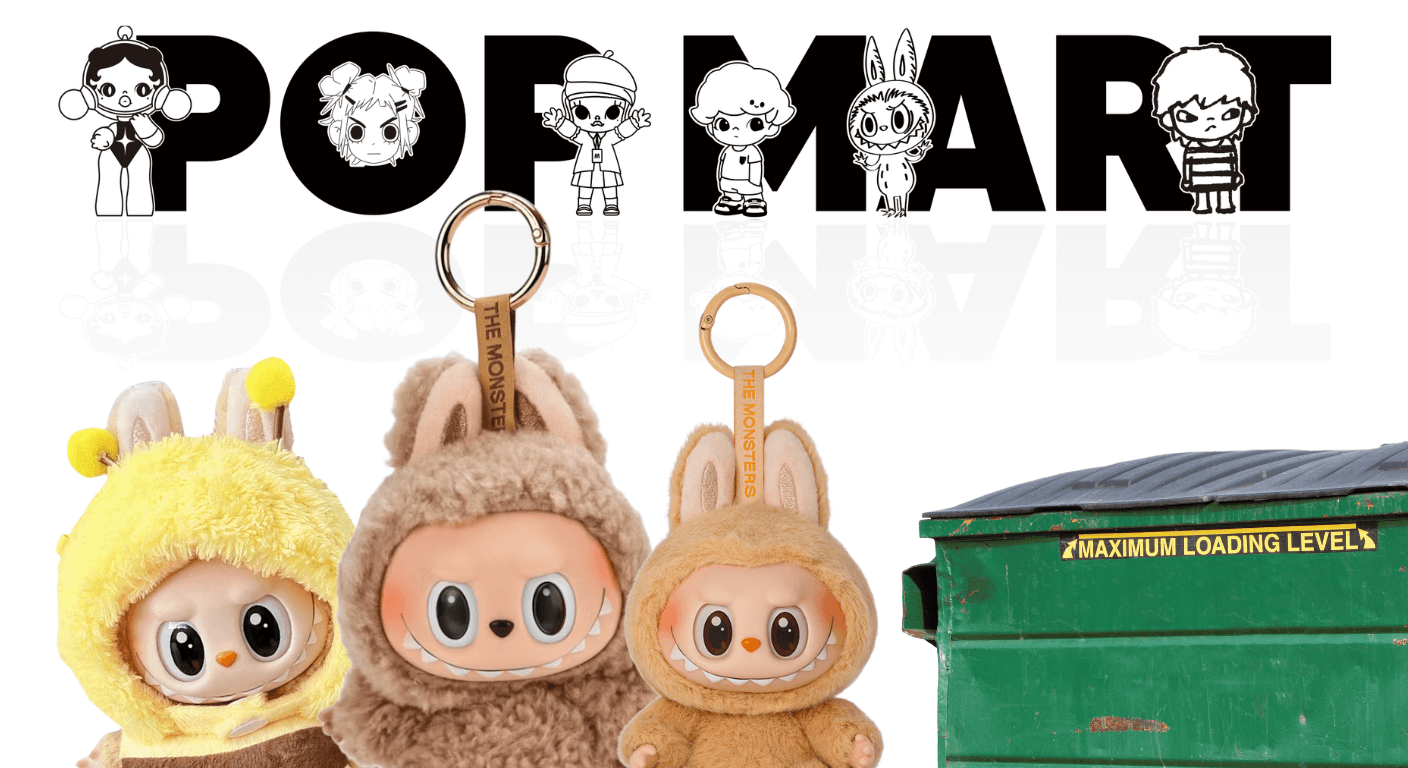
Pop Mart's revenue grew 75 to 80% year over year in the first quarter of 2026. The stock crashed anyway.
That's the disconnect that has the designer toy world arguing right now. A company posting growth most brands would kill for. A share price that has shed roughly 60% from its peak.
Both things are true at the same time. The story is in why.
Three Different Stock Numbers, Don't Mix Them Up
The headlines keep blurring these together. They mean different things.
Down 22% in a single day. That was March 25, 2026, after earnings.
Down 25% since late March. That's the slide over several weeks.
Down 60% from the August 2025 all-time high. That's roughly $33 billion in market cap gone. It followed a run-up of about 300% from early 2025 into August.
So Pop Mart (Hong Kong listed, 9992.HK) is still up huge over the longer arc. It's the round-trip off the peak that stings.
The Deceleration Is the Real Story
Pop Mart did CNY 37.1 billion in 2025, roughly $5.5 billion. Full-year revenue grew 185%.
Q1 2026 grew 75 to 80% on unaudited numbers. Still enormous. But less than half the pace of the year before.
US sales fell in April 2026. Bloomberg's headline put the drop at 45%. Other coverage said 42%. Either way it's a sharp reversal in the market that was supposed to carry the next leg of growth.
Google Trends tells the same story. Search interest in Labubu peaked in August 2025 and fell sharply after. The hype curve has a shape now, and the top is behind it.
The One-IP Problem
Pop Mart makes a lot of characters. It mostly sells one.
The Monsters series, which includes Labubu, was about 40% of 2025 revenue. That's up from 23% in 2024. The company got more dependent on its hit, not less.
Labubu was created by Belgian-Chinese illustrator Kasing Lung. There's a reported Labubu movie attached to Paul King, the Paddington director, though that hasn't been confirmed.
The worry is what comes after. Crybaby and Molly, the other Pop Mart lines, underperformed. "Can they find the next Labubu" is the question every analyst is now asking.
The analysts don't agree on the answer. Morgan Stanley forecasts 13% growth and cut its price target from HK$278 to HK$247. Deutsche Bank's Sammi Xu sees a contraction of roughly 2% and cut from HK$157 to HK$140. Management is still guiding to "at least 20%."
When the spread between bull and bear is that wide, nobody actually knows.
The Secondary Market: Then and Now
Peak hype had a face. A human-sized mint-green Labubu, about 4 feet 3 inches tall, sold for ¥1.08 million at Yongle International Auction in Beijing on June 10, 2025. Roughly $150,275 for a single figure.
That was the top of the curve. So where is the resale market now?
Honestly, the data is thin. There are no deep verified sold-comp records here the way there are for graded cards. What exists comes from price guides, not confirmed sales. Treat the numbers as directional.
By those price guides, common Labubu figures sit around $25 to $60. That's roughly 1.5 to 3x retail, which is softer than the multiples flying around last summer.
The rare chases look different. The 1:72 pulls like "Big Into Energy" and "Wings of Fantasy" appear to be holding around $1,700 to $2,000 per the guides.
That split matters. The commons are cooling while the genuine scarcity holds. That complicates any clean "Labubu crashed" headline. It didn't all move together.
Buy the Dip or Beanie Baby Moment?
That's the question collectors keep asking. It's worth asking honestly instead of answering it like a fortune teller.
The Beanie Baby parallel is real on one axis. A blind-box plush line, mass produced, riding a hype wave, with a secondary market full of people who arrived to flip rather than collect. That ended one way in the late '90s.
But the comparison isn't clean. A 1:72 chase that genuinely got pulled at a 1:72 rate is scarce in a way a "retired" Beanie Baby with millions in circulation never was. Scarcity that's real and scarcity that's marketed are not the same thing.
So the distinction collectors should hold onto is the one between hype commons and genuine scarcity. A $40 common that's down from $80 is a hype-supply story. A $1,800 chase holding its number is a scarcity story. They could move in opposite directions from here.
What to Watch
Pop Mart sits in the same designer toy and "kidult" plush conversation as Squishmallows and Jellycat. The difference is concentration. Squishmallows spreads risk across thousands of designs. Pop Mart bet most of its growth on one set of characters.
Watch the next non-Labubu launch. Watch whether US sales keep sliding. Watch whether the chase figures hold their guide prices once more comps actually print.
The collecting principle underneath all of this hasn't changed. Verified scarcity and genuinely limited product tend to weather a correction. Mass-produced hype-supply tends to find its real level on the way down. The Labubu market is just running that experiment in public right now.