LEGO's May 2026 Retiring Soon update added more than 90 items. 95 in the US. 86 in the UK. 111 across the EU.
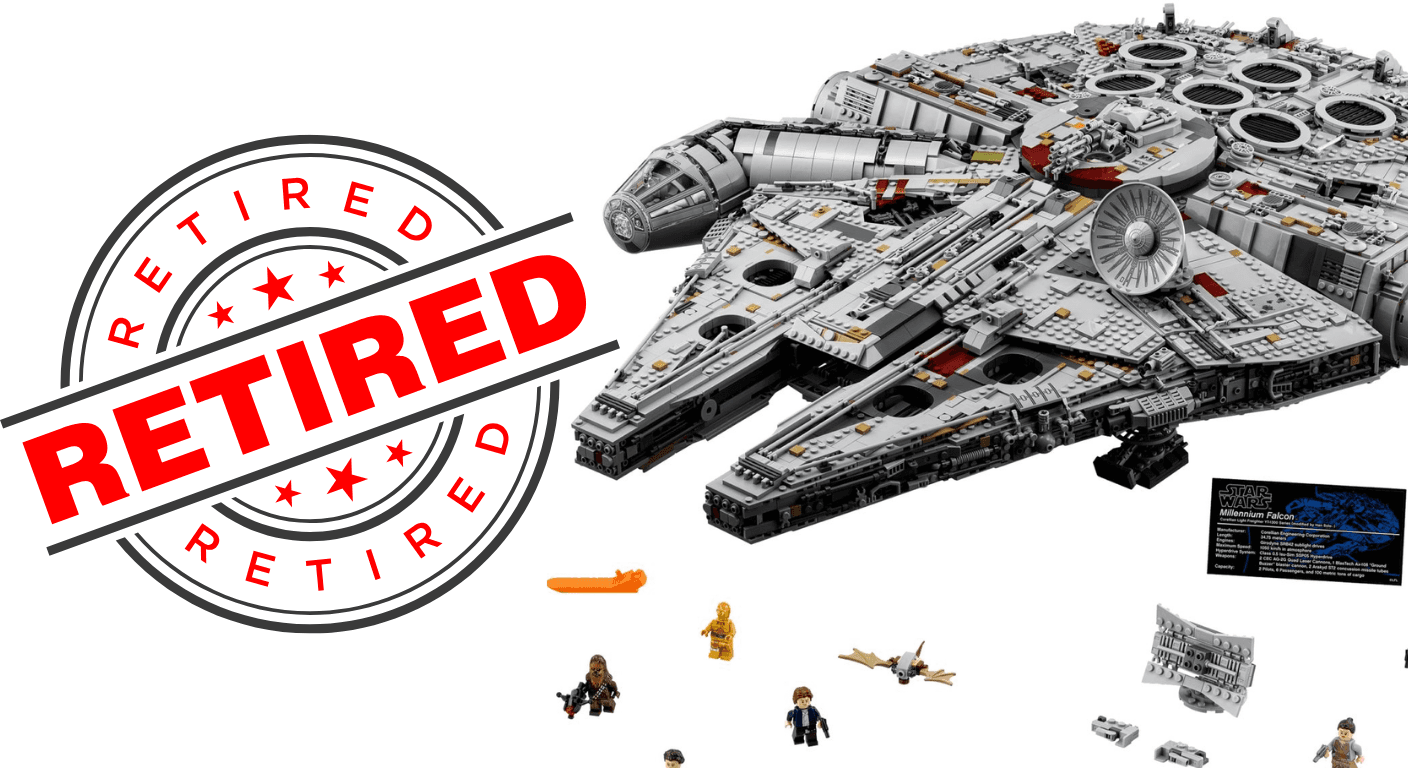
The headline name on the list: 75192, the UCS Millennium Falcon. $849.99. 7,541 pieces. On shelves since September 2017.
It was the biggest set LEGO had ever made when it launched in 2017, and it's now scheduled to leave by December 31, 2026.
What's Leaving
The Falcon isn't alone in the Star Wars exit lane. Three more are scheduled to retire by the end of 2026.
75367 Venator Republic Attack Cruiser. 75382 TIE Interceptor. 75397 Jabba's Sail Barge.
Outside Star Wars, the big one is 10307 Eiffel Tower. $629.99. 10,001 pieces. Its retirement got bumped from July to December 31, 2026.
A separate batch retires sooner, by July 31. The list:
21348 D&D Red Dragon's Tale ($359.99). 21350 Jaws ($149.99). 21352 Magic of Disney ($99.99). 76417 Gringotts Collectors' Edition. 77092 Great Deku Tree. 76917 2 Fast 2 Furious Skyline GT-R R34. 71426 Piranha Plant.
A note on the Falcon before anyone panics. Its retirement has slipped before. LEGO pushed it from 2025 to 2026 back in August 2024. So treat December 2026 as scheduled, not carved in stone.
Why Retirement Moves Prices
Same lesson as the LEGO Pokemon sets. The retirement date matters more than the launch date.
A LEGO set has fixed supply. Once it's retired, LEGO stops making it. No restocks. No "more inventory is coming." The pool of sealed copies only shrinks from there as people open them to build.
That's deliberate scarcity. LEGO retires sets on purpose, and the secondary market knows the clock is running. The last-chance effect kicks in. Buyers who were on the fence pile in before it's gone, which props up retail demand right up to the cutoff.
Then the new copies dry up, and the only place to get one is a reseller.
The Historical Playbook
Here's where the Falcon's pedigree gets interesting. Its predecessor tells the story.
The original 10179 UCS Millennium Falcon launched in 2007 at $499.99 and retired in May 2010. It now averages around $1,989, with sealed copies near $2,660. That's roughly 298% over retail (BrickEconomy, late May 2026).
Other UCS-tier sets followed similar paths. The 10030 UCS Imperial Star Destroyer (2002, $269.99) sits around $1,595 sealed on BrickEconomy's conservative read, up roughly 491%. Note that valuation is contested. Some sources put it as high as $3,000 to $5,000, so treat it as a wide range, not a fixed number.
The 10189 Taj Mahal ($299.99) runs about $999 sealed, up around 233%.
Zoom out and the averages cool off fast. A 2021 academic study in Research in International Business and Finance, cited by The Hill, found LEGO sets returned about 11% annually from 1987 to 2015. BrickNerd pegs retired sets broadly at roughly 10% to 15% per year on average, and stresses how variable that is.
Now the hedges, because they matter more than the highlight reel.
Most sets do not become the Falcon. The big appreciators are the exceptions, not the rule. Condition drives a huge share of the value, and sealed copies command the premium. An opened-and-built set is worth a fraction of what the box on the headlines fetches.
There's also a successor risk. A redesigned UCS Falcon could follow the old one, the way 75192 followed 10179. If that happens, it can soften the premium on the version retiring now. Buyers waiting for the "definitive" Falcon might sit on their hands.
And every dollar figure above is a point-in-time snapshot as of late May 2026. Past results are not a forecast.
The Takeaway
Buy what you'd be happy to build and keep on a shelf. That's the version of LEGO collecting that never disappoints you.
Buying a sealed copy for upside is fine. Just don't treat it as a guaranteed flip. The Falcon could climb the way its predecessor did, or a redesign and a shaky market could flatten it. Both are on the table. Past performance is not the future, and most sets never make the highlight reel.