The scanner is half the job.
Buy the wrong one and you'll spend more time fighting double feeds and clipped card tops than listing cards. Buy the right one and you'll image a long box while you drink your coffee.
This is the part nobody tells you. Hardware gets you a clean front and back. Software does the matching, the pricing fill, and the listing. eBay's fee structure decides whether listing that card was even worth your time. All three have to line up.
Here's how to pick, the top five, and the math behind it.
First Question: What Do You Actually Sell?
Before you spend a dollar, answer three things. They decide everything.
Raw, sleeved, or slabbed? A bare raw card, a card in a penny sleeve and toploader, and a graded slab are three different scanning problems. Most consumer scanners handle the first two. Almost none handle slabs.
What volume? Hundreds of cards a month is a different machine than thousands a day. A full-time dealer and a weekend seller should not buy the same scanner.
One vendor or a mix? If your value is in graded and chromium singles, you need a contactless overhead unit. If it's bulk commons by the thousand, you need a fast sheet feeder. Most sellers run a mix and pick the machine that fits the bulk of their inventory.
ADF vs Overhead: The Core Split
Almost every option falls into one of two camps. Pick the camp first, then pick the model.
ADF (automatic document feeder) scanners pull cards through rollers, front and back in one pass. Fast, cheap, great for raw and toploaded cards in volume. The catch: rollers touch the card, alignment matters, and they cannot scan a graded slab.
Overhead (contactless) scanners shoot down at a card or slab sitting on a mat. No rollers, no scratches, and they handle slabs, sealed cases, and chromium refractors. The tradeoff is speed. You're placing cards one at a time.
1. Epson WorkForce ES-400 II: The Budget Entry
Price: roughly $329 to $380 as of June 2026.
This is the entry point for a seller doing hundreds of cards, not thousands. Duplex ADF, 35 pages per minute, and 600 DPI, which is the sweet spot for card imaging.
The gotchas matter here. Remove the roller for penny sleeves and toploaders. Put it back for raw cards or you'll get constant double feeds. Set a small scan margin of about 0.05 inches or it clips the tops of cards and everything looks off-center.
One more warning. A misaligned glossy or chromium card can get scratched on the way through. It cannot scan slabs. For a part-time seller working through raw and sleeved singles, it's the cheapest way in.
2. Epson WorkForce ES-580W: The Wireless Pick
Price: about $379.99 as of June 2026, on sale from $449.99.
Same 600 DPI duplex engine as the ES-400 II. The difference is the workflow. It adds Wi-Fi, a 4.3 inch touchscreen, and a 100-sheet ADF, so you're not tethered to a computer to run a batch.
The limits carry over. No slabs. Watch your alignment the same way you would on the ES-400 II. If you want the same image quality without a cable running to your desk, this is the one.
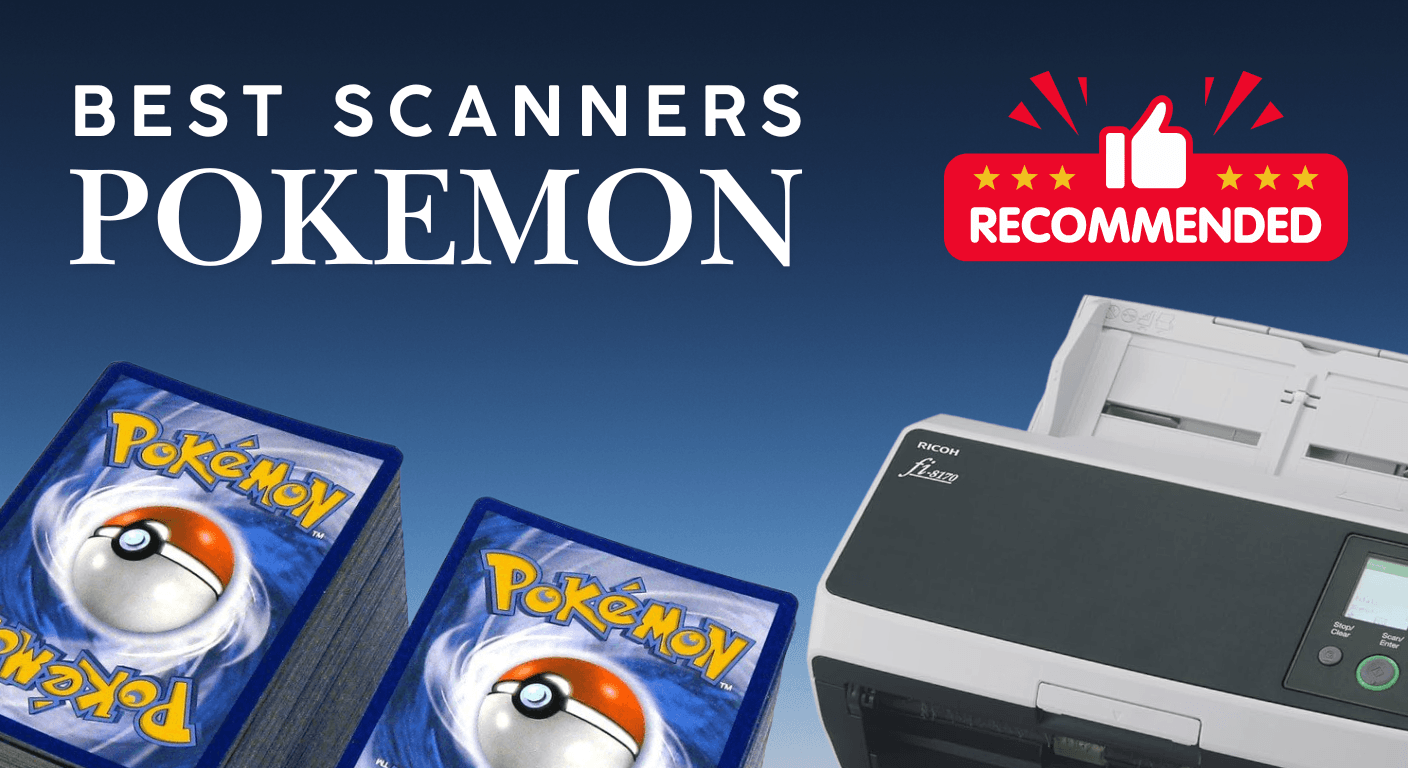
3. Ricoh fi-8170: The High-Volume Workhorse
Price: roughly $640 to $800 new as of June 2026, cheaper refurbished.
This is the full-time dealer's machine. It's the official Card Dealer Pro partner scanner, and it moves 3,000 to 4,000 cards per hour in real-world use. Note: Ricoh acquired the Fujitsu scanner business, so the fi-8170 is Ricoh (formerly Fujitsu).
If you're listing thousands of singles a week, the speed pays for the price difference fast. The Epsons will bottleneck you. This won't.
Same hard limit as every ADF unit. It cannot scan slabs. This is a raw and toploaded volume machine, full stop.
4. Ricoh ScanSnap SV600: The Slab and Chromium Specialist
Price: about $575 to $690 as of June 2026.
Different tool for a different problem. The SV600 is a contactless overhead scanner. It shoots down at whatever you put under it, so it scans graded slabs, one-touches, and sealed cases that no sheet feeder can take.
Because there are no rollers, there's nothing to scratch. That makes it the pick for refractors and chromium cards that the ADF machines can mark up.
It's slower per card. You place each one by hand. But if your money is in graded cards and high-end shiny singles, that's the right trade.
5. Heystack One: The All-In-One
Price: gated. Heystack runs pricing through a webinar and account signup, sells it as a bundle with software credits, and availability is limited. Contact them for a quote.
This is the only device built specifically for cards, from Heystack (heystack.tech). It does both slabs and raw or toploaded cards, with shadow-free and glare-free capture, a Bluetooth capture button, and around a five-hour battery.
The pull is the integration. It's built to feed Heystack's AI software, which claims 98% match accuracy and a "Release Day Matching" feature for brand-new sets. If you want one device that handles your whole table and a tight software pipeline behind it, this is the all-in-one.
The Software Layer Matters as Much as the Hardware
A clean scan is useless until something matches it, prices it, and lists it. This is where most of the time goes.
Card Dealer Pro. Monthly tiers at $9, $19, and $59 as of June 2026, plus AI credits, with a 7-day trial. It does AI matching and lists to eBay, Shopify, and CollX. The honest criticism: you still price cards manually. The comps work is on you.
CardUploader. Free to start, supports 30-plus TCGs, fills prices from TCGplayer and eBay, exports an eBay CSV, and lists to eBay, Shopify, Whatnot, and TCGplayer. Paid pricing is in flux, so use the free tier to start and check current pricing before you commit to a paid plan for unlimited listings.
Heystack software. Credit-based, and the credits never expire. It works with the Heystack One, Ricoh scanners, flatbeds, and even phone photos, so you're not locked into one capture device.
Also worth a look: Kronozio, CollX, and Ludex.
The eBay Math That Decides Everything
This is the part that changes which cards are worth listing at all.
Non-store sellers get 250 zero-insertion-fee listings per month. After that, it's $0.35 per listing in standard categories. A Starter store runs about $4.95 per month with 250 free listings and $0.30 per additional. The Anchor store is $299.95 per month with roughly 25,000 free listings.
Here's the wall. A $0.49 bulk card with a $0.30 to $0.35 insertion fee on top does not work. You lose money before shipping.
High-volume bulk selling on eBay only pencils out with a store tier. That's why a lot of bulk sellers keep bulk on TCGplayer and put the mid-value singles, reverse holos, full arts, and double rares, on eBay. Scan everything. List it where the fee math works.
The Recommendation Matrix
Match the machine to what you sell.
Budget raw seller: Epson WorkForce ES-400 II.
Want wireless and a touchscreen: Epson WorkForce ES-580W.
Full-time, high volume: Ricoh fi-8170.
Slabs and chromium: Ricoh ScanSnap SV600.
One device for everything: Heystack One.
The scanner gets you a clean image. The software and the fee math decide whether the card was worth listing. Buy for the cards you actually sell, not the ones you wish you sold.