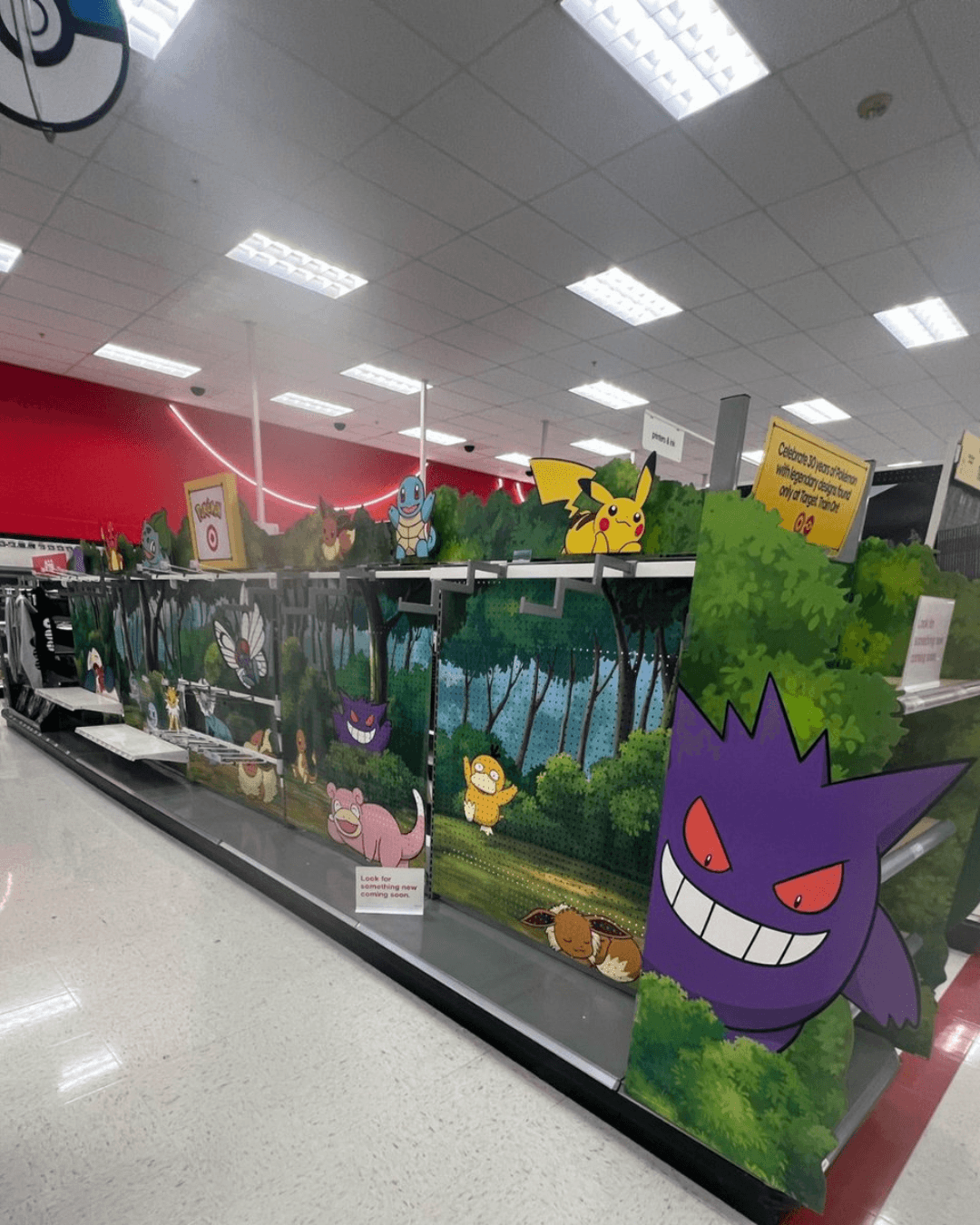
Reports surfaced on May 2 that Target locations had in-store Pokemon promotional displays removed and listed on eBay before the end of the launch day. Items Target wasn't even selling. Promotional fixtures, according to the eBay listings and social-media documentation that followed.
That's the launch experience for the biggest Pokemon retail moment of 2026.
A box of Pokemon Pop-Tarts. $2.89 at retail. Sold listings on eBay dated May 2 hit $20, $22, $24.99. That's a 7-9x markup inside a few hours on a $3 grocery item.
Target sold out. The Pokemon Company won the cultural moment. The collectors who actually wanted any of this got steamrolled. Three things happened. They are not the same thing.
The Collab On Paper Is Beautiful
I want to give credit where it's due. The 30th anniversary collection is a smart cultural play.
100+ exclusive items. Apparel, accessories, beauty, home goods, food. Nearly half the assortment under $20. Entry pricing starts at $3.50. That's a real attempt at accessibility on paper.
Joe Jonas led the campaign as a longtime Pokemon fan. The nostalgia partner list is genuinely good. Mead bringing back the Trapper Keeper. Caboodles. Lip Smacker. A first-of-its-kind Pokemon Starter jacket from the original Starter brand. Binder-inspired Trapper Keepers. Kickballs. Butterfree hair clips. Life-size 151-piece puzzles riffing on the original Kanto region.
Pokemon GO timed research integrated in Target stores. Character meet-and-greets at the SoHo Target flagship. A second drop on June 6.
Target is "the only U.S.-based mass retailer" partnered with TPC for the anniversary. That is a flex. That is the marquee retail placement of the year for the most valuable IP in the world.
The strategy team at Target won. The brand team at TPC won. The campaign team won.
Now here's what actually happened in the parking lot.
Now Here's What Actually Happened
Most popular items sold out within hours. A lot of them were gone online before fans could even reach checkout.
One widely shared account had stores receiving FIVE Kanto starter jackets total. One per size. That's the entire allocation for a national retailer location. Five units of the marquee apparel item.
Long lines. Aggressive crowds. Customers rushing displays. Videos circulated of fans getting shoved off jackets they had just grabbed. Reports compared it to sneaker-drop chaos.
The Kanto Starter Jacket was $129.99 at retail with a 4-per-customer limit. The 4-per-customer limit "helped contain the damage." That phrase did a lot of work. The jacket immediately listed on eBay for $250+. After a 13% eBay fee, that's around $87 in profit per unit. Multiply by four. That's the math the scalpers ran in the parking lot before they walked in.
The Pop-Tarts hit 7-9x within the same day.
And then the displays. Scalpers literally walked into Target stores and removed in-store Pokemon promotional displays. Items Target wasn't selling. Promotional fixtures. Listed on eBay the same afternoon.
That's not a launch the brand can be proud of. That's a launch losing its own fixtures to the resale market.
TPC Keeps Winning. The Base Keeps Bleeding.
Here's the part nobody at TPC wants to say out loud. This is not new. This is the pattern.
Stellar Crown sold out in minutes. Surging Sparks sold out in minutes. Prismatic Evolutions sold out in minutes. Every Pokemon Center restock since late 2023 has sold out in minutes. ETB drops at every major retailer have been bot fodder for two years. Online presale codes for fan events have triggered crowd-control incidents covered by mainstream outlets. GameStop staff have reported customer threats over TCG allocations, and GameStop ultimately killed Pokemon preorders entirely. A London TCG drop earlier saw shoppers force their way past gates, per multiple reports. Now we have a Target launch with shoved-off customers and stripped store displays.
The pattern isn't a bug. It's the product.
TPC has had 24+ months of identical signal. Every drop sells out in minutes. Every aftermarket spikes 5-10x. Every retail partner becomes a scalper farm. Every fan event ends with the same complaint thread on Reddit and X.
They keep saying they'll fix supply. They keep not fixing supply.
And here's the asymmetry that should bother everybody. TPC keeps winning the brand moment. The press coverage on this 30th launch is uniformly glowing. Lifestyle positioning. Joe Jonas. Trapper Keepers. The marketing wrap will be a case study at every brand conference for the next three years.
The fans funded that brand moment with their bodies in line and their wallets on eBay aftermarket. They got nothing in return. Or they paid 2-10x to get something they should have been able to buy at retail.
Pokemon could be the most valuable IP of this decade if the collector base trusted the supply. They don't. And the trust gap is entirely TPC's to close.
It's a Print Run Problem and TPC Is Choosing Not to Solve It
Strip away the apparel and the Pop-Tarts and the SoHo activations. The structural issue is allocation.
Print capacity has been the bottleneck on the TCG side for two years. Millennium Print Group (TPCi-owned) handles North America. Cartamundi handles Europe and shares its plant with other TCGs. TPCi has publicly said it's printing at max capacity, and the new Millennium campus expansion isn't fully operational until 2028. Two-plus years of "we're working on it" while every drop runs as artificial scarcity. The licensed merch is now copying that same playbook.
Limited drops are great when the product is artisanal. A small artist run. A handmade collab. 200 units of something genuinely special.
Limited drops are a problem when the IP holder is running the largest entertainment franchise in human history. Pokemon's lifetime gross is north of $150 billion across games, cards, anime, merch. That is not an artisanal scale. That is a Disney scale. A McDonald's scale.
Compare this to LEGO. LEGO prints to demand. The casual gift buyer at Target gets the set. The AFOL community gets the set. Resellers exist on certain retired items, but the secondary market on a current-production set is sane. LEGO Stores do not generate crowd-control headlines.
LEGO chose that. TPC has chosen the opposite. Every Trapper Keeper that gets bought four-deep by a flipper at $40 retail and listed at $150 the same night is a choice. Every five-jacket allocation per store is a choice. Every Pop-Tart hitting $24.99 within hours is a choice.
The market has been telling TPC the same thing for 24+ months. They are choosing to ignore it because the brand moment keeps landing and the cards keep printing aftermarket value.
Why This Is the Opening for Collectors-First Brands
Here's the part the founders in this category should be paying attention to.
Every single fan who got blown out at Target this weekend is a customer right now looking for a venue that respects them. That is a massive, addressable pool of disappointed buyers.
Whatnot is going to win some of them. Live commerce, real humans selling, transparent pricing in real time. CardVault is going to win some of them. 14 stores, on-site experience, grading service, an environment that isn't a parking lot stampede. The local card shop in your city is going to win some of them. The LCS that holds product back for regulars at MSRP is the most underrated retail format in the entire hobby right now.
Nerdbase is built on the same thesis. Collectors-first. Marketplace experiences that don't require you to outrun a bot or kick down a gate.
The retail partner of choice for the biggest collectibles franchise on Earth has now become a venue where customers report being shoved off product and where promotional fixtures end up on eBay. That is the opening. That is what the underdogs have been waiting for.
When the marquee event of the year ends with crowd-control footage circulating and 7x Pop-Tart flips on eBay, every collector-first marketplace in the category becomes more valuable by Monday morning. That includes mine. I'll say that out loud.
The Brand Wins. The Fan Loses. The Flippers Eat the Middle.
Target's PR team called it a sellout. The customer experience said otherwise.
TPC has the data. Two years of every drop selling out in minutes. Multiple fan events ending in crowd-control incidents. Every retail partner turning into a scalper farm. The distribution model has not changed.
The collector base deserves better. The IP deserves better. The franchise deserves better.
Until TPC fixes supply, every "exclusive collab" is going to read like this one. The brand wins. The fan loses. The flippers eat the middle.