Five years ago, a sealed copy of Super Mario Bros. selling for six figures seemed absurd. In 2021, one sold for $2 million. That record still stands. And the market that produced it has only gotten bigger.
The retro gaming collectibles market hit $3.8 billion in 2025 and is projected to cross $4 billion this year. That's a 10% compound annual growth rate, roughly triple the pace of the broader gaming console market. Heritage Auctions runs dedicated video game sales every month now. Goldin moved sealed games into its Pop Culture Elite tier alongside vintage comics and sports cards.
This is not a niche anymore.
The Price Tags
A sealed Super Mario Bros. holds the all-time record at $2 million. Super Mario 64 hit $1.56 million. A sealed Legend of Zelda went for $870,000. These are the trophy assets, the ones that get CNBC segments and disbelief from non-collectors.
But the mid-tier is where the real market lives. At Goldin's February 2026 Pop Culture Elite auction, a sealed Pokemon Crystal Version (Game Boy Color) sold for $73,244. A sealed Mike Tyson's Punch-Out brought $26,230. A sealed 1985 Super Mario Bros. graded WATA 8.0 went for $26,108.
Heritage ran a Nintendo 8-to-64-Bit auction in January 2026. It realized $181,266 from 495 bidders. Not headline money. But consistent, liquid demand for sealed games across price points. That's what a real market looks like.
Two Graders. One Owns the Other.
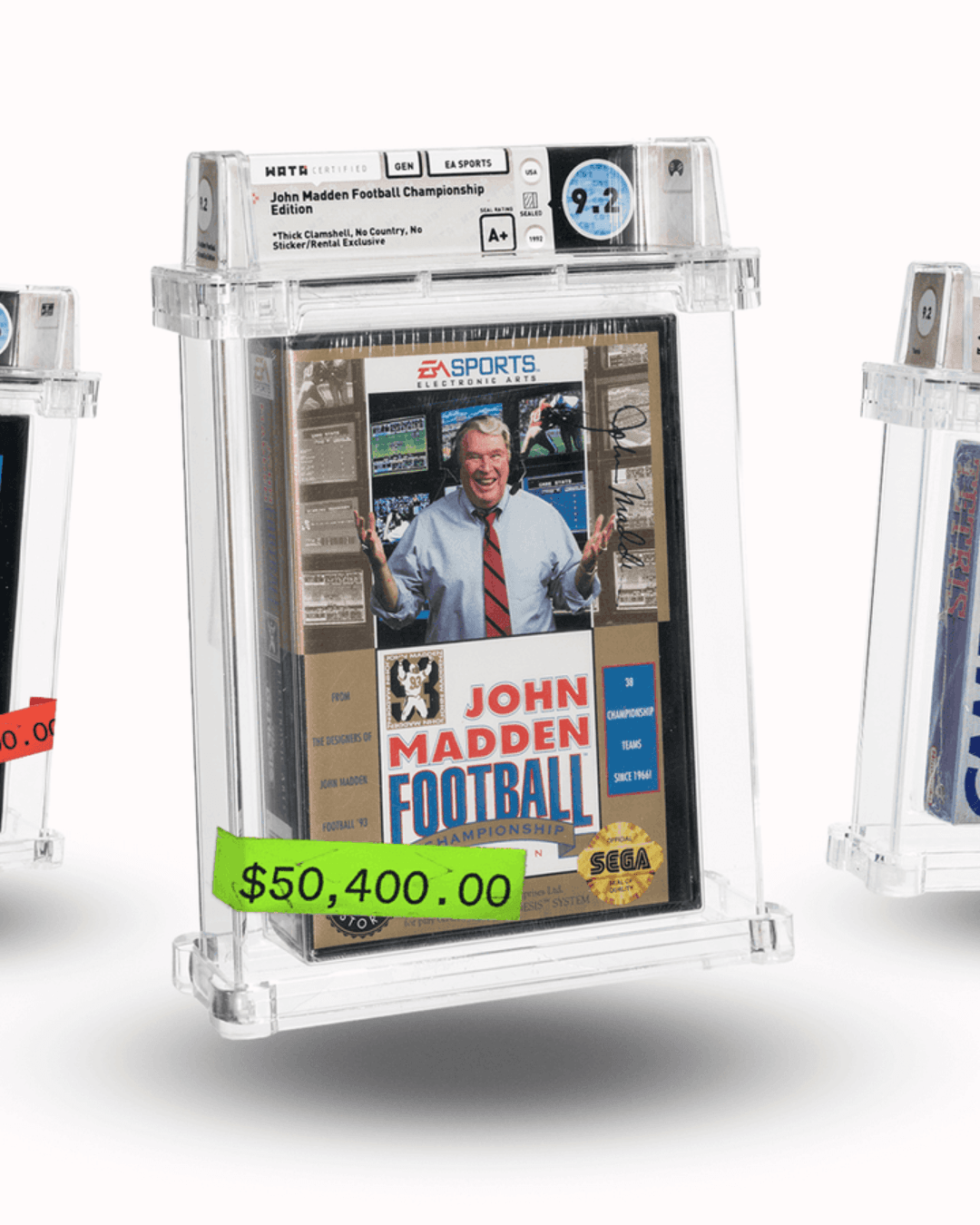
The sealed game market runs on third-party grading. Same concept as PSA and CGC for trading cards. A sealed game in a graded case with a numerical score is worth multiples of the same game ungraded.
For years, the two major graders have been WATA Games and CGC. But here's the thing. WATA was acquired by Collectors Holdings, PSA's parent company, back in 2021. And in 2025, WATA quietly rebranded under the PSA name entirely. The company that dominates card grading now controls the dominant video game grader too.
CGC is the independent alternative. Backed by Blackstone through Certified Collectibles Group, the same entity behind CGC Comics. They use a 10-point scale. WATA used a 100-point scale before the rebrand. CGC holders tend to sell for 20-50% less than equivalent WATA grades at auction, though that gap has been narrowing as CGC gains market share.
In January 2026, CGC expanded its video game grading to new platforms. Famicom. Japanese Game Boy, Game Boy Color, and Game Boy Advance. Atari Jaguar. TurboGrafx-16. PS1. Dreamcast. They also simplified their tier structure down to two options, Standard and WalkThrough, and raised prices.
The expansion matters. It signals CGC sees international and multi-platform retro games as the next growth lane, not just sealed NES and SNES cartridges from the American market.
The Scandal That Won't Go Away
You can't talk about sealed game values without talking about what happened in 2022.
YouTuber Karl Jobst published a detailed investigation alleging that WATA Games and Heritage Auctions had conflicts of interest that inflated sealed game prices. The accusation: WATA's grading created artificial scarcity distinctions, Heritage sold them at inflated prices, and insiders profited on both sides.
A class-action lawsuit followed in May 2022, filed in California. The plaintiffs alleged RICO violations, unfair competition, false advertising, and market manipulation. Before WATA existed, the most expensive game ever sold was a $30,000 copy of Super Mario Bros. on eBay in 2017. Two years after WATA started grading, the same title sold for $100,000. Then $2 million.
WATA called the allegations baseless. The lawsuit has not produced a public settlement.
The controversy didn't kill the market. But it made collectors more skeptical of grade-driven valuations, especially at the top end. And it's part of why CGC's entry into video game grading was welcomed. Competition and a second opinion.
What This Looks Like Going Forward
The market is projected to reach $8.5 billion by 2033. CGC is expanding platforms and building international infrastructure. Collectors Holdings (PSA/WATA) controls the largest share of graded inventory and the auction relationships.
For collectors, the fundamentals haven't changed. Condition matters. Provenance matters. First-print variants of iconic titles hold value better than anything else. A sealed copy of a game you actually played as a kid will always carry emotional weight that no market report can quantify.
For speculators, the WATA controversy is a useful reminder. Grading companies are businesses. Auction houses are businesses. Neither one is a neutral arbiter of value. The $2 million Super Mario Bros. is real. The question is whether the infrastructure that produced that price is trustworthy enough to sustain it.
At Goldin's February 2026 auction, a sealed copy of the original 1985 Super Mario Bros. graded WATA 8.0 sold for $26,108. Not $2 million. Not even $100,000. Just a well-preserved copy of a 41-year-old game, priced like a decent used car. That's probably the most honest data point in the entire market.