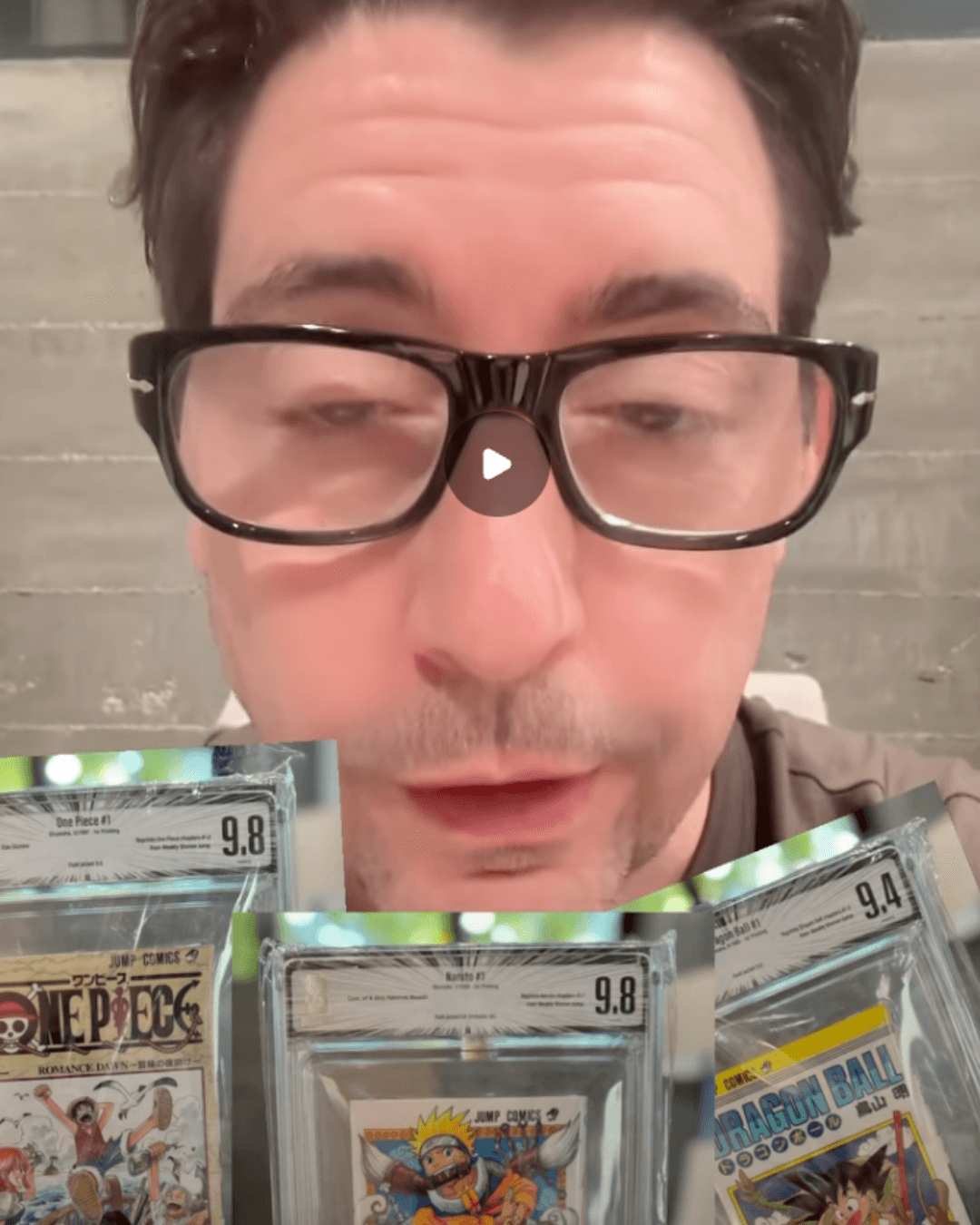
Jeremy Padawer just paid $275,000 for three books. Dragon Ball Vol 1 graded 9.4. Naruto Vol 1 graded 9.8. One Piece Vol 1 graded 9.8. The highest-graded copies of all three. All in one transaction. He's calling it a world record for graded manga.
The previous record for a single graded manga sale was $20,000. A Naruto Vol 1 9.8, sold privately. Padawer didn't just break that record. He obliterated it by a factor of 13.
This is the same person who paid $193,000 for a first-edition Harry Potter and the Philosopher's Stone. The world record for any book published in the last 50 years. He owns one of only 12 complete PSA 10 1999 Pokemon 1st Edition sets.
And in January 2025, he lost his entire collection in the Pacific Palisades fire.
He's Not Buying Back What He Lost
Padawer is the Chief Brand Officer of Jazwares and becomes President on March 20. Jazwares is owned by Berkshire Hathaway. It's the fourth-largest toy company on the planet.
He's not rebuilding his old collection. He's building a new one. Over $1.25 million invested in manga in the last six months. The $275,000 purchase is the centerpiece, but it's not the whole bet.
"I'm a 10X in 10 year collector who follows my passion into categories I deeply understand," Padawer said in his announcement. He believes manga and Japanese anime influence "has surpassed anything the world has ever seen." He thinks collectors under 30 will drive valuations to levels nobody is pricing in right now.
He called it his potential "greatest return of all time."
The Grading Market Is Two Years Old
Here's the part that matters for collectors watching this from the outside. BGS launched manga grading in January 2024. The entire graded manga market is two years old.
Dragon Ball Vol 1 tops out at 9.4. That's the highest known grade. Population 2. There are no 9.8s. No 10s. For a book that sold 260 million copies worldwide, the graded supply at the top is almost nonexistent. Naruto and One Piece both came in at 9.8. Near-perfect copies of the two series that defined an entire generation of readers.
Padawer is essentially buying the rarest copies of the three most culturally significant manga series ever published. Dragon Ball. Naruto. One Piece. The Big Three. And he's doing it at the moment when grading infrastructure is still being built.
The Seller: Grailmonster
The books came from Frank, known online as @grailmonster. He's one of the most prominent high-value collectibles dealers in the hobby. In July 2023, he sold a Golden Ticket 2-Pack Funko Pop for $210,000. That was the largest Funko sale ever recorded.
Frank said he sold "because it's good for the hobby." A sale at this level, from a known figure, to a known figure, with a public announcement, does more to legitimize graded manga as a collectible category than any amount of marketing could.
The Manga Market Is Real
The raw numbers support the thesis. Manga sales have quadrupled since 2019, growing 27x faster than the total print book market. The global manga market hit $19.01 billion in 2026.
But it's not all momentum. The Japanese manga market contracted 14.4% in 2025. That's the first decline in seven years. The growth story is real, but it's not uniform. International demand is carrying the market while the domestic Japanese side cools.
For graded manga specifically, the market barely exists yet. There's no established price history. No robust comp data. No auction house running dedicated manga sales at scale. Padawer is buying into a category where the infrastructure is still being assembled.
That's either visionary or early. Sometimes those are the same thing.
What This Signals
A Berkshire Hathaway executive doesn't spend $1.25 million in six months on a category he thinks is going sideways. This is a directional bet on manga as the next major collectibles vertical, the same way sports cards were 10 years ago and Pokemon was five years ago.
The fire took everything. He could have spent $1.25 million replacing what he had. He chose to bet on what he thinks comes next.
The graded manga market just got its first six-figure sale, its first public world record, and its first institutional-grade collector. All in one transaction. Whether the prices follow is the only question left.