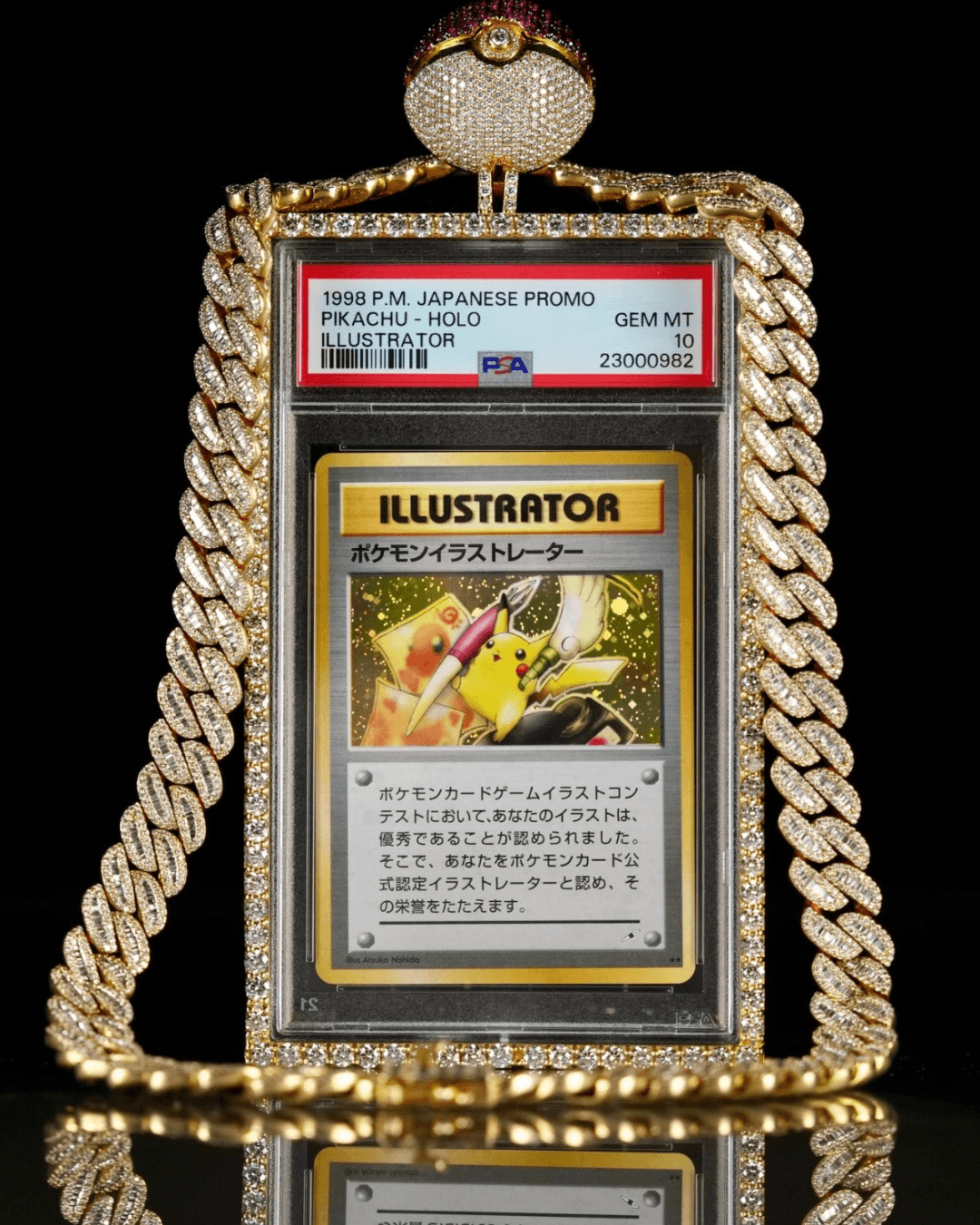
Nine days after paying $16,492,000 for the only PSA 10 Pikachu Illustrator in existence, AJ Scaramucci went on CNBC and made a bigger claim than the purchase itself. Collectibles aren't just collectibles anymore. They're investments. And the data, he argued, proves it.
"The compounded annual growth rate of these cards is out of control," Scaramucci said on February 25. "They should be treated as investments because that's what they are."
He called trading cards a way to play the "debasement trade." Hard assets against currency devaluation. The same logic people use for gold, real estate, and Bitcoin. Except the asset is a 2.5-inch piece of cardboard with a yellow mouse on it.
The Numbers Are Real
Card Ladder, the Bloomberg Terminal of trading cards, backs up the headline stat. Pokemon cards are up 145% in the past year. The S&P 500 returned 15.2% over the same period. Alphabet, one of the Magnificent Seven, gained 73.4%.
Zoom out and it gets more dramatic. Over 20 years, Pokemon cards have returned 3,261%. The S&P 500 returned 483%.
Monthly secondary market volume has nearly doubled in two years. In January 2026 alone, $450 million was spent on Pokemon cards.
Those are real numbers from a real data provider. They're also incomplete. More on that in a minute.
The Man Behind the Thesis
AJ Scaramucci is the founder and managing partner of Solari Capital, a multi-stage VC firm. Yes, he's Anthony Scaramucci's son. But he's building his own track record.
Solari Capital led a $220 million investment in American Bitcoin, the Trump-family-connected crypto mining firm.
His new venture is called Treasure Trove. The plan: acquire high-profile collectibles and trophy assets. The Illustrator Pikachu was the first move. He's also said he's going after a T-Rex fossil and a copy of the Declaration of Independence.
This isn't a collector building a personal collection. It's a financier building a media-aware investment thesis around physical assets.
The Bull Case
The institutional signals are hard to ignore. The sports trading card market alone was valued at $11.52 billion in 2024, projected to reach $23.64 billion by 2034.
PWCC, the largest trading card marketplace, reports its 500 Index is up 434.3% since 2020. In 2022, they secured a $175 million credit facility from WhiteHawk Capital. That's the kind of financing traditionally reserved for asset classes with institutional legitimacy.
Ken Goldin called collectibles an "accepted alternative asset" on CNBC. Sotheby's and Christie's now regularly feature premium cards. The money is moving in one direction.
The Bear Case
Collectibles are what Wall Street calls "sterile assets." They generate zero cashflow. No dividends. No yield. After storage, insurance, and transaction costs, the cashflow is actually negative. You're paying to hold them.
The Knight Frank Luxury Investment Index fell 3.3% for the second consecutive year. That index tracks high-end collectibles across categories. It's not all up-and-to-the-right.
Then there's survivorship bias. That 3,261% figure tracks the most popular, most liquid Pokemon cards. It doesn't account for the thousands of cards that went nowhere.
Fortune called this kind of selective data "Boy Math." Cherry-picked returns that look spectacular because you're only measuring the winners.
The broader Pokemon market has cooled 30-50% from its 2021 highs. Sealed product cratered. The speculator wave receded. The Illustrator is a trophy asset, not a market indicator.
And there's the liquidity problem. You can sell an S&P 500 index fund on a bad Tuesday. You cannot sell a $16 million Pokemon card on a bad Tuesday. Illiquidity is a feature for patient capital. It's a nightmare for everyone else.
Right Idea, Wrong Comparison
Scaramucci is probably right that collectibles are becoming a recognized asset class. The institutional money, the data infrastructure, the auction house credibility signals. It's all pointing that way.
But comparing Pokemon cards to the S&P 500 is misleading. Stocks represent ownership in companies that generate revenue, pay dividends, and buy back shares. A Pokemon card sits in a vault.
The correct comparison isn't equities. It's gold, wine, fine art. Assets that appreciate based on scarcity and demand, not earnings.
By that standard, collectibles perform well. A million dollars invested in the Knight Frank index in 2005 would be worth $5.4 million today. The same million in the S&P 500 would be worth $5 million. Close. Competitive. But not the 10x outperformance the Card Ladder numbers suggest.
Thirty Years From Toy to Trophy
Today is Pokemon Day. Thirty years ago, these were toys stuffed into kids' backpacks. Now one of them is worth more than most apartment buildings in America.
Whether that makes Pokemon cards an asset class or just an expensive hobby with good marketing depends on who you ask. Scaramucci is putting serious money on the former. The actual returns, once you strip out survivorship bias and factor in illiquidity, tell a more complicated story than either side wants to admit.